In an attempt to use up some of the seed that has been slowly expiring at the bottom of my seed box I spent the morning making my own Salad Leaf seed mix. I don’t know about you but I always end up with a bunch of seed packets that don’t contain quite enough seed for a full row. I can’t bear to throw seed away (I’ll carry on sowing it at least three times before I’ll admit it’s totally dead). So a bespoke seed mix seemed just the thing to clear things out.
As you can see from the photo I’ve included Spinach, Rocket, Mizuna, English Mustard (so they will be a spicy little bunch). But I’ve also added three types of Lettuce; All the Year Round, Salad Bowl and Drunken Woman (it has red flecks on the leaves). And I also threw in some Beetroot for their leaves and a nice earthy taste.
Predictably, I’ve called it My Tiny Salad Mix. And have already sowed a huge swathe of it next to my Strawberry patch. We’ll see how it tastes.

I went to the Spring Gardening Show in Malvern this weekend. It’s always lovely to see so many gardeners walking around with basketfuls of plants. This year there seemed to me to be more than the average number of nurseries selling unusual plants and flowers. I even thought about buying a Clematis! Still thinking.
One stand caught my eye though, it was chock full of heirloom Tomatoes. The Tomatoes were beautifully displayed in coconut shells and miniature gardens and made me want to plough my whole plot and plant nothing but Tomatoes! Very inspiring. The ones pictured above are Green Zebra (on the left) and Striped Stuffer (right).

I forgot to make a note of the name of this Tomato but it could be Green Sausage.

I love the shape of this huge Tomato. It’s called Pearson and looks to me like it might need the protection of a greenhouse. Large Tomatoes normally do.

These little apple-shaped Tomatoes are Ceylon. I might give them a try outdoors this year. I bet they’re prolific and mouth-wateringly sweet.

I like to grow at least one Tomato that isn’t red. This one looks amazing. It’s called Tangella and is unusual enough to spice up any plate.
I do find that some Heirloom Tomatoes are not very appetising to look at. Some of them are, well, just ugly. Some of the black ones even make me wince a bit. Anyone with me on that one?

Finally, this is a photo of the whole stand. I really love the passion here. Heck. I know they’re trying to sell Tomato seed and it’s their business but from the effort that has gone into this you just know that they breathe Tomatoes. I’m grateful that someone is so passionate about it to make this wonderful display that really made my day.

I went to my local seed swapping event today, Seedy Sunday. Now is a great time to swap your saved seed and get something new to grow that you may not have grown before.

Others thought so too as it was already packed with people swapping, chatting and consuming tea and cakes.
There was a book swap table, to which I donated my Alan Titchmarsh Kitchen Garden book,

Ian from More Veg, helped Jackson and I choose some seeds from his stand.

And even though we didn’t actually donate any seed we managed to come away (by way of a donation) with a packet of Cress and some Fennel.
And… I found out that Simpson’s Seeds nursery is actually in the old kitchen garden at Longleat house. So that one is on my ‘gardens to visit’ list for the summer.

I harvested my Coriander plants at the end of the Summer and hung them up in the shed window to dry. They have been there ever since and are currently providing a nice little home for my resident shed spiders – of which there are many.
About a week ago I decided to harvest some of the seed and started to pop them off the plant and collect them on the bench. I was amassing quite a little pile when, oh I don’t know, something happened to distract me. Could have been a waking baby, that’s mostly what distracts me these days. Anyway, I went back into the house and forgot to put the seeds in my seed box. Huge mistake.
I went back the next day and the seed were, you guessed it, gone! Only slightly gnawed at seed casing had been left behind. I could also hear the mice groaning from the weight of their full bellies. Darn it.
Well, at least the mice are happy. And at least I have more back-up seed hanging in the window. Contingency seed, that’s the key.

This year I grew some Sweetpea Currant Tomatoes, a not-so-little bush variety that produces Tomatoes no bigger than a pea. They were beautiful. Not only did they taste very, very sweet but their tiny jewel-like fruits looked amazing on the plants and produced bucket-loads of Tomatoes. They were a real hit. The only problem is that the seed is quite expensive. If my memory serves me well they were £2.45 for ooh… about 15 seeds. In seed terms that’s quite a bit. So I have determined to save my own seed, since I have so many Tomatoes I might as well!
The first thing to do is to pick some nice, ripe Tomatoes (check). Cut them in half and scoop out the seeds. Put these into a jar and place in a warm cupboard to ferment – or get mouldy in plain terms. After about a week the jelly-like substance will have err.. rotted off. Nice huh?

Next fill the jar with water and skim off any bad seeds that float to the top. Wash the remaining seeds with fresh water.

Finally, turn them out onto a towel to dry thoroughly and store in a dry, frost free place until next year.
As I understand it you can save seed from any Tomato in this way. But, you have to be careful which Tomatoes you save seed from as some will cross pollinate in certain situations.
Tomatoes are self-fertile which means they don’t need insects or wind to pollinate them. But… some are pollinated by insects if the anthers on their flowers open up and allow insects inside. Or if the stigma sticks out beyond the anthers and insects can get to it. This can happen on the first flowers that beefsteak Tomatoes produce and currant varieties.
Aha, you say, but you have just saved the seed from a currant variety. Yes, you can do that if you are only growing one currant variety. Also if you discard any plants that do not produce Tomatoes that are true to type in the future.
So, if you have a bunch of ripe Tomatoes still hanging on for dear life, don’t bin them. Save yourself some money by saving the seed.

This year I’m growing a new variety of Tomato (for me at least) called Sweet Pea Currant. The shops were full of the tiny pea-sized Tomatoes last year and they were all the rage in mum’s circles because toddlers loved them.
I hadn’t seen the seed for sale until this year and I’ve even seen small plants for sale at some garden centres too – finally they veer away from racks and racks of Gardeners Delight, Shirley and Alicante (nothing wrong with those varieties but it’s nice to see something new).
Anyway, I’m growing Sweet Pea Currant with some seed that I got from Victoriana Nursery. But there are other places to buy the seed.
Apparently the plant is a cordon type but you should treat it as a bush variety because if you pinch out all the side shoots then the yield will be too small. As I’ve never grown them before I’m not sure how big the plants will be but I’m guessing smaller than your average Tomato.
I can’t wait to harvest the sweet little Tomatoes and I’m sure that once Jackson finds them he will be picking them himself and I won’t get a look in.
Anyone else growing this type? What is your flagship Tomato this year?

I recently received my copy of Which? Gardening and there was a fascinating feature in it about the differences between heritage vegetables (ie those older varieties that would die out if not perserved) and newer hybrid varieties.
Which? are famed for their thorough testing and they certainly seemed to have tested some obvious varieties of each type of veg. The old and new varieties were grown under identical conditions, in the West Country and each were tested for yield, looks and taste. I won’t recount the whole feature here but the headline results were as follows:
Calabrese
Old Variety – Green Sprouting
New Variety – Ironman F1
Winner = New variety, with excellent flavour
Tomato
Old Variety – Brandywine
New Variety – Country Taste F1
Winner = Old variety, for flavour
Parsnip
Old Variety – Tender and True
New Variety – Picador F1
Winner = New variety, for all round quality
Carrot
Old Variety – St Valery
New Variety – Infinity
Winner = Old variety, for flavour
Lettuce
Old Variety – Parris Island
New Variety – Chartwell
Winner = Old variety, for taste
Dwarf French Beans
Old Variety – Triomphe de Farcy
New Variety – Speedy
Winner = New variety, for supermarket-quality beans (not sure what that means, straight?)
Beetroot
Old Variety – Detroit Globe
New Variety – Pablo F1
Winner = Old variety, for taste and yield, New variety for looks
Sweetcorn
Old Variety – Golden Bantam
New Variety – Lark F1
Winner = New variety for sweetness
Courgette
Old Variety – All Green Bush
New Variety – Endurance F1
Winner = New variety for taste and good looks
Whether you agree with using F1 hybrid varieties or not, it’s useful to see where their strengths are and where you really don’t need to use them. Especially, since F1′s tend to be very expensive. For my part I’ll always be choosing to grow something called, ‘Triomphe de Farcy’ over its F1 rival ‘Speedy’. I mean, who wouldn’t?
Which? don’t seem to have put the article online yet, otherwise I would link to it.

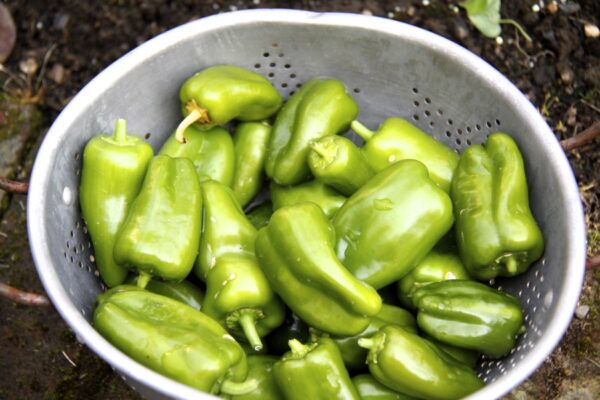
I harvested all of my Bell Peppers today (Capsicum). I didn’t realise that the three plants I had were so laden with fruit. I’ve harvested about 15 Peppers – not bad!
The only problem is that they are a bit bitter. Too bitter to eat raw at least. It’s disappointing, especially since they look so gorgeous. I’ve grown Peppers before and not had this problem. But as you know, there is always one crop that doesn’t go to plan each year, even if you think you have it nailed. So I turned to my books for an answer.
After some research I think my problem is that we had a dry summer, I planted them against a sunny wall and they didn’t get enough water. I should have off-set the dry summer with regular watering. And although I did give the garden extra water I just don’t think the Peppers got enough. Apparently, if they don’t get enough water the result is bitter Peppers.
I should say that the Red Peppers are bitter too, although not as bad as the Green ones. Does anyone have any tips on what I can make with these? Or are they seed fodder?

Some of my Borlotti beans had naturally started to dry on the wigwam so I decided to put some aside for seed next year (I’m definitely growing Borlotti Beans again!). Just a few tips for saving Borlotti Bean seed:
- Leave them on the plant as long as you can
- Ideally wait to pick the pod until it’s gone dry and crispy
- If you have to pick them, dry them at room temperature inside
- Pop open the pods and extract the beans
- Place in a breathable container, like a brown paper envelope
- Label and store in a frost-free, damp-free place
Roll on next year! What are you saving? And any tips for doing it?

The Balcony Gardener send me these seeds last week. I just love the way they are packaged. The designs on the front of the seeds are lovely and they make me feel good about being a gardener in the 21st Century.

I think traditional seed packers could learn a thing or two from this type of design. My hunch is that the kind of people who used to buy seeds are being replaced by a different kind of buyer but the seed packet design really hasn’t changed much has it?
Does anyone else have examples of simple, lovely seed packet design?
The Balcony Gardener seeds are available here.